GreenMorph: Green Neuromorphic
- This page is under preparation.
- Blog post on our ISCAS 2026 publication: https://blog.e3computing.org/2026/03/18/carbon-neutral-ai-rethinking-how-intelligence-uses-energy/
Brief description
In this research, we investigate designing a low-power neuromorphic computing solution for IoT and Edge devices by combining Approximate Computing and Approximate Stacking Memory. As IoT and edge devices have become ubiquitous, it is necessary to have the ability to calculate the neural networks on the devices using dedicated chips/modules. However, current neural network architectures are power intensive, especially for deep neural networks, which prevents them from being able to be widely adopted. As a result, there is a need for low-power solutions for Neuromorphic Computing. In this research proposal, we combine Approximate Stacking Memory with Approximate Computing to improve energy efficiency further while maintaining overall accuracy.
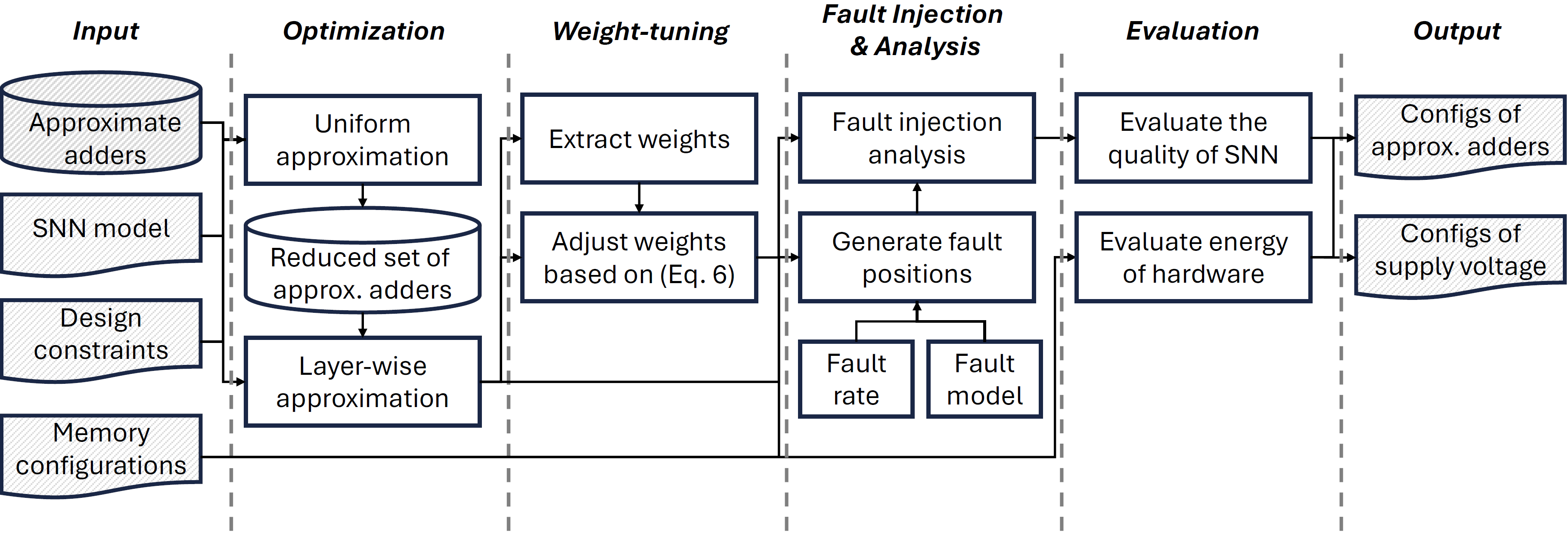
 Caption: The Approximation Framework for SNN.
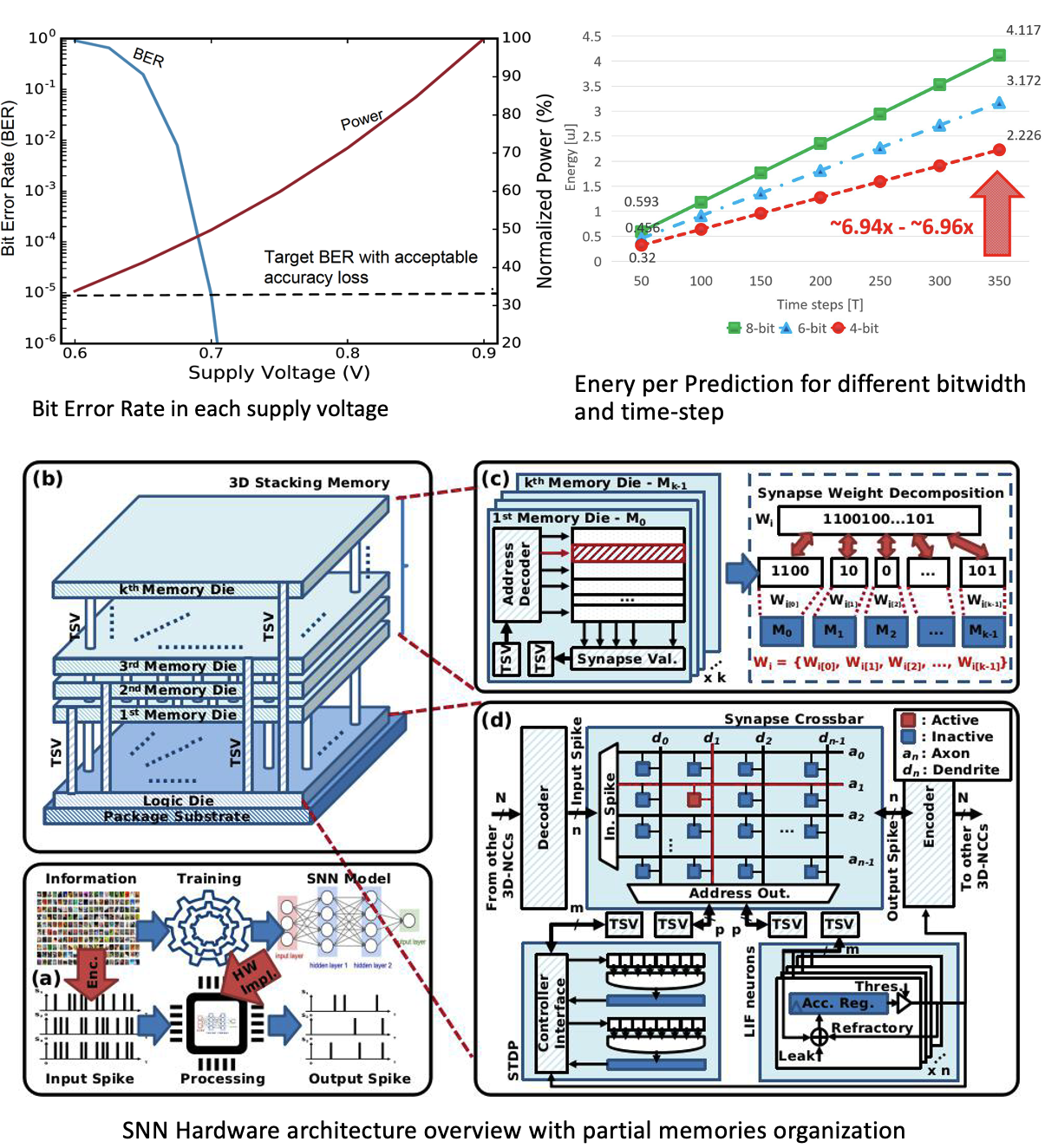
Caption: Voltage-Scaling and Partial-Power-Gating for Stacked SRAM.
Results
Open-source
HeterGenMap: An Evolutionary Mapping Framework for Heterogeneous NoC-based Neuromorphic Systems
- Description: In this project, we deploy a Genetic Algorithm for mapping large-scale Neuromorphic Systems.
- Link: [Github]
Patents
- Khanh N. Dang, A. Ben Abdallah, Nguyen Ngo Doanh[^1], ''Neural Network Processor'' [ニューラルネットワークプロセッサ], 特願 2024-047372, Japan patent, (filed patent). [Presented in JST University Fair 2025] [Google Patent]
- Khanh N. Dang, A. Ben Abdallah, ''Homogeneous computing system and migration flow generation program for homogeneous computing device” [ホモジニアスコンピューティングシステム及びホモジニアスコンピューティングデバイスのマイグレーションフローの生成プログラム], 特願 2022-196416, Japan patent, (patent pending). [Google Patent]
Papers
- Ryoji Kobayashi and Khanh N. Dang, ''An Efficient Hardware Implementation of Spiking Neural Network Using Approximate Izhikevich Neuron''. 2024 9th IEEE International Conference on Integrated Circuits, Design, and Verification, June 6-8, 2024. [URL]
- Ngo-Doanh Nguyen, Khanh N. Dang, Akram Ben Ahmed, Abderazek Ben Abdallah, Xuan-Tu Tran, ''NOMA: A Novel Reliability Improvement Methodology for 3-D IC-based Neuromorphic Systems'', IEEE Transactions on Components, Packaging and Manufacturing Technology*, 2024. [URL]
- Yuga Hanyu and Khanh N. Dang, ''EnsembleSTDP: Distributed in-situ Spike Timing Dependent Plasticity Learning in Spiking Neural Networks'', 2024 IEEE 17th International Symposium on Embedded Multicore*Many-core Systems-on-Chip (MCSoC), Dec. 16-19, 2024. [URL]
- Ryoji Kobayashi, Ngo-Doanh Nguyen, Nguyen Anh Vu Doan and Khanh N. Dang, ''Energy-Efficient Spiking Neural Networks Using Approximate Neuron Circuits and 3D Stacking Memory'', 2024 IEEE 17th International Symposium on Embedded Multicore*Many-core Systems-on-Chip (MCSoC), Dec. 16-19, 2024. [URL]
- Khanh N. Dang, Nguyen Anh Vu Doan, Ngo-Doanh Nguyen, Abderazek Ben Abdallah, ''HeterGenMap: An Evolutionary Mapping Framework for Heterogeneous NoC-based Neuromorphic Systems'', IEEE Access, vol. 11, pp. 144095-144112, 2023. [DOI: 10.1109/ACCESS.2023.3345168]/[Source Code].
- Ngo-Doanh Nguyen, Akram Ben Ahmed, Abderazek Ben Abdallah, Khanh N. Dang, ''Power-aware Neuromorphic Architecture with Partial Voltage Scaling 3D Stacking Synaptic Memory'', IEEE Transactions on Very Large Scale Integration Systems (TVLSI), vol. 31, no. 12, pp. 2016-2029, Dec. 2023. [DOI: 10.1109/TVLSI.2023.3318231].
- Ngo-Doanh Nguyen, Xuan-Tu Tran, Abderazek Ben Abdallah, Khanh N. Dang, ''An In-situ Dynamic Quantization with 3D Stacking Synaptic Memory for Power-aware Neuromorphic Architecture'', IEEE Access, vol. 11, pp. 82377-82389, 2023. [DOI: 10.1109/ACCESS.2023.3311031].
- Ngo-Doanh Nguyen, Khanh N. Dang, ''A Novel Yield Improvement Approach for 3D Stacking Neuromorphic Architecture'', 2023 IEEE 16th International Symposium on Embedded Multicore*Many-core Systems-on-Chip (MCSoC), Dec. 18-21, 2023.
Funder
- Competitive Research Funding (Ref. 2023-26): Low-power Spiking Neural Network Solution for IoT and Edge devices
- Competitive Research Funding (Ref. 2024-24): Combination of Approximate Computing and Approximate Stacking Memory for Low-power Neuromorphic Computing